
My name is Nicole (she/her), I am a queer AuDHD academic librarian, geographer, artist and writer.
I am currently working at the University of Guelph Library, as a Research and Scholarship Librarian.
I hold a Bachelor of Science in Environmental and Earth Sciences from Dalhousie University (2018), a Master of Spatial Analysis from TMU (2019), and a Master of Information from the University of Toronto (2024).
I am extremely interested in exploring how dominant pedagogical approaches, within higher education institutions can reproduce and sustain epistemic harm, cognitive ableism and exclusionary structures related to knowledge, productivity and authority. My current research project examines how (re)storying my own scholarship and educational experiences might inform more reflective, identity-oriented approaches to my librarianship praxis.
Through a critical auto-ethnographic framework, I am (re)visiting my 2018 graduate research dissertation, I am (re)engaging with my research and writing, and the process of scholarly publication, as sites for return and critical reflection. This retrospective engagement examines how my positionality as a first-generation student, alongside my subsequent diagnosis as Autistic and having ADHD following the completion of the original research, I hope to explore this (re)contextualizes my understanding of scholarship, authorship, and academic norms.
Through this approach, I seek to create space for Autistic, neurodivergent and marginalized ways of knowing, creating, sensing, and navigating institutional contexts, both within and beyond existing structures. At the same time, I am interested in how revisiting earlier writing and research can function as a creative and reflexive practice as a librarian; one that opens space for questioning dominant academic narratives while imagining more relational, accessible, and affirming ways of engaging in knowledge production.
My work is grounded in an advocacy-oriented commitment to challenging exclusionary practices in higher education and reimagining more relational, accessible, and affirming approaches to learning and research. Additionally, it attends to the ways racism, colonialism, and capitalism intersect to shape institutional conditions, while opening possibilities for solidarity, refusal, care, and more subversive forms of inquiry.
My Teaching Philosophy
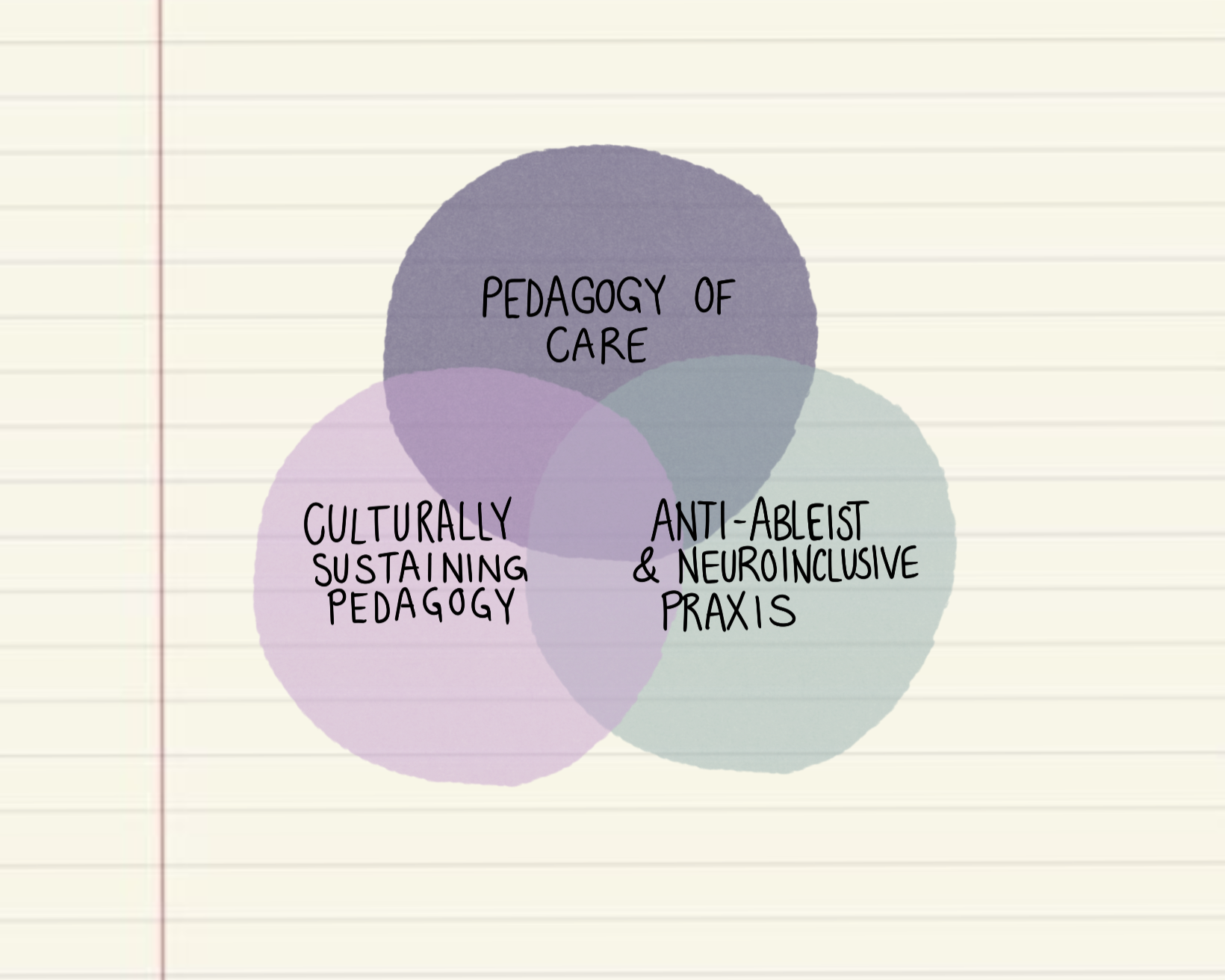
My teaching framework interweaves a pedagogy of care, culturally sustaining pedagogy and anti-ableist and neuro-inclusive praxis.
My teaching practice focuses on creating learning spaces that feel supportive, clear, and respectful of different ways of thinking and learning. I recognize that research is not only an intellectual process, but also an emotional one.
As an academic librarian, I see learning as more than just understanding content. It also involves how people relate to knowledge, to institutions, and to themselves. In doing so, I hope to acknowledge how higher education systems reinforce unequal power structures that cause harm, especially for radicalized, marginalized, disabled and neurodivergent learners. My work involves staying grounded within these realities and intentionally building more supportive and inclusive learning environments.
In my teaching, I aim to:
Acknowledge and validate the emotional aspects of research
Support different learning speeds and styles
Revisit ideas and questions more than once
Make expectations and “hidden rules” explicit
Offer multiple ways to engage with information